
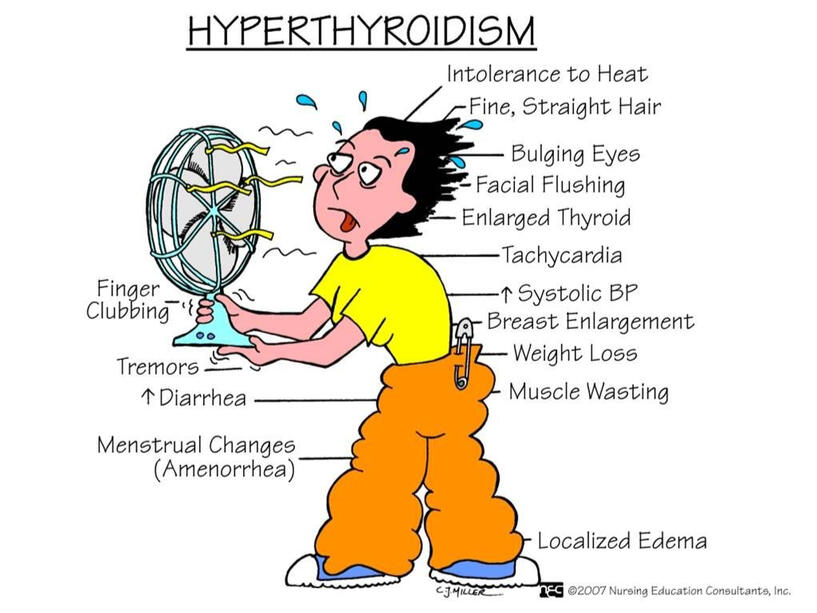
What is hyperthyroidism?
Hyperthyroidism occurs when the thyroid gland becomes overactive and produces excess thyroid hormones. Hyperthyroidism is different from hypothyroidism and should not be confused. HYPER means over active whereas HYPO means under active.
What is the cause of Hyperthyroidism?
The most common form of hyperthyroidism is a condition called Graves’ disease. In this disease, the body's immune system begins to attack the very organs and tissues that it’s supposed to protect. This leads to excessive production of thyroid hormone by the thyroid gland. Additional symptoms include swelling of the neck due to enlargement of the gland, and protrusion of the eyes.
There is also a form of hyperthyroidism that develops soon after birth. This is a temporary condition that resolves within 3 to 6 months. Some treatment may be required but there are no long-term problems. For all other types of hyperthyroidism, treatment will be required.
What are the Symptoms of Hyperthyroidism?
The most common symptoms include:
• Enlargement of the thyroid gland • Weight loss • Excessive sweating and feeling too warm when others are comfortable • Rapid heart rate and palpitations • Poor school performance • Mood swings, including irritability • Difficulty sleeping • Bulging or prominence of the eyes • Tremors of the hands • Increased frequency of bowel movements, or diarrhea
All of the above features are not necessarily seen in every child or adolescent with hyperthyroidism.
How is hyperthyroidism Diagnosed?
Diagnosis is done by taking a single blood test to check for thyroid hormone levels (FT3, FT4, TSH). High FT3, FT4 levels along with low TSH levels suggest a diagnosis of Hyperthyroidism. A thyroid scan and uptake may be done to review thyroid shape and size, look for nodules, and check to see if the thyroid is overactive (uptake).
How is hyperthyroidism treated?
Antithyroid medications
The most common method of treatment of hyperthyroidism is administration of anti-thyroid medication, which stops the thyroid gland from making and releasing thyroid hormone. The drug of choice is Methimazole. Another anti-thyroid medication, propylthiouracil (PTU), is not used often in children, because it is associated with more frequent serious side effects.
Methimazole can be associated with side effects including an itchy skin rash (hives), and rarely joint and muscle pains and aches, jaundice (skin and eye yellowing from a liver problem), and a low white blood cell count, which might make it hard to fight infection. If one of these side effects occurs, another form of treatment must be used. These drugs may control the disease but will not cure it. However, after 2 years of treatment, about 30% of patients may be able to safely stop medication for at least a period of time, and some may be able to stop medication forever.
The advantage of this treatment in contrast to the use of radioactive iodine or surgery is that a child may not become permanently hypothyroid and need to take a thyroid pill every day.
Radioactive Iodine
Radioactive iodine is safe to use as a treatment in young people. Radioactive iodine is given in the form of an oral cap- sule or drink and destroys the thyroid gland over a few months, without causing major symptoms. This leads to hypothyroidism, which is the inability to make enough thyroid hormone.
Radioactive iodine should never be used in a girl who is pregnant or will become pregnant very soon because of risk of damage to the unborn baby’s thyroid gland. Young people treated with radioactive iodine will eventually need to take a replacement thyroid pill every day for the rest of their lives.
Thyroid pills are very safe and do not interfere with normal growth and development and health.
Surgery
Surgical removal of the thyroid gland is also an effective way to treat hyperthyroidism. Risks include damage to the parathyroid glands, which are usually attached to the thyroid and control calcium in the blood, or damage to the recurrent laryngeal nerve, which is nearby and could lead to a hoarse voice. It is very important that thyroid surgery be performed by an experienced thyroid surgeon to minimize these risks. If there is a complication of antithyroid medications, family members can decide whether they prefer treatment with surgery or radioactive iodine.
Beta Blockers
In the early stage of treatment, beta blockers like propanolol or atenolol are used to increase the comfort level of the young person with hyperthyroidism. These drugs will not affect thyroid hormone levels but can help in general well-being by controlling symptoms like palpitations, tremors, and anxiety as well as rapid heart rate.